
Protecting the asphalt you have
Sealcoating & Crack Sealing in Greensboro, NC
Keeping water out of cracks before winter and sun off the binder in summer.
- Free on-site estimates
- Written quote that lists base depth and asphalt thickness
- Subgrade checked before any new asphalt goes down
Maintenance That Adds Years
Sealcoating and crack sealing are the two maintenance steps that do the most to extend the life of asphalt. Crack sealing fills open cracks so water cannot reach the stone base and the clay below. Sealcoating puts a thin protective coat over the surface to slow the drying and fading caused by sun and oxygen. Neither one adds strength to failing pavement, so both belong on asphalt that is still structurally sound.
Why it matters in the Triad
Greensboro averages about 75 nights a year at or below freezing, and freezing rain is common in the Piedmont. When water sits in a crack and freezes, it widens the crack a little more each time. In summer, long, hot, humid stretches oxidize the surface and turn it gray. Filling cracks in late summer or fall and sealing every few years cuts down both kinds of damage.
Crack sealing first
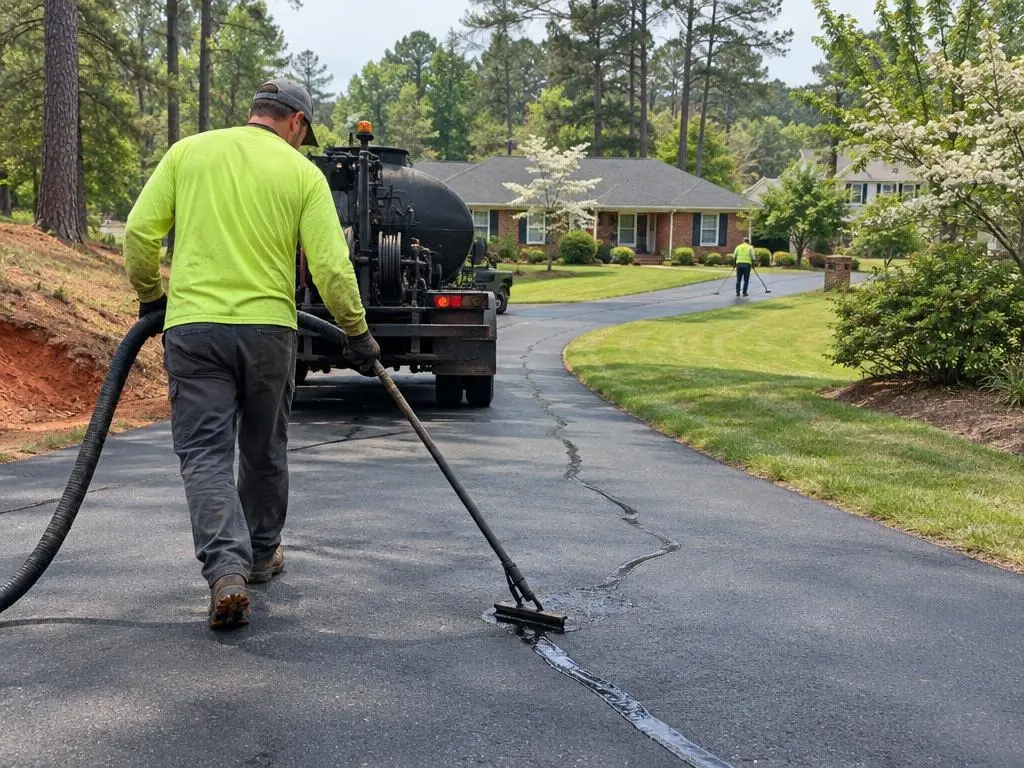
We clean each crack with air, and on wider cracks we route or rout them out so the filler has a clean edge to bond to. Hot-pour rubberized filler stays flexible as the pavement expands and contracts. Wide alligator-cracked areas are not good candidates for crack filling; they need patching.
Preparing for sealcoat
- Blowing and sweeping the surface, including along edges
- Scraping and priming oil and fuel stains so the sealer bonds
- Filling cracks before sealing so sealer does not just sink into them
- Edging by hand along garage slabs, walks and curbs
Skipping prep is the usual reason a seal job peels within a season.
When to seal
HomeGuide advises waiting 3 to 6 months after paving before the first coat, and resealing every 2 to 10 years depending on the product and weather. The working range is 50 to 95 degrees in dry weather, and cars should stay off for 12 to 72 hours afterward. In Greensboro that usually means spring and fall, plus dry summer mornings.
Sealer types
HomeGuide notes that coal tar sealers resist fuel stains but have been banned in many places over health and environmental concerns, while asphalt emulsion sealers are considered more environmentally friendly but stain more easily from gas and oil. We tell you which product we plan to use before the job.
What This Covers
Clean, fill, prime, seal, in that order.
Hot crack sealing
Cleaning and filling cracks with flexible hot-pour filler.
Oil-spot treatment
Scraping and priming stains so the sealer bonds.
Driveway sealcoating
Sealer applied by squeegee or spray with hand-finished edges.
Parking lot sealcoating
Lots sealed in sections, then restriped once the coat cures.
Typical Sealcoating Costs
| Item | Published range |
|---|---|
| Driveway sealcoating (HomeGuide) | $1 to $2 per sq ft |
| One-car driveway, 288 sq ft (HomeGuide) | $290 to $580 |
| Two-car driveway, 400 sq ft (HomeGuide) | $400 to $800 |
| Three-car driveway, 864 sq ft (HomeGuide) | $860 to $1,700 |
| Crack filling (HomeGuide) | $0.50 to $3 per linear ft |
| Crack filling, typical driveway (Angi) | $100 to $400 |
| Parking lot sealcoating (HomeAdvisor) | $0.15 to $0.30 per sq ft |
National ranges from published cost guides, not local quotes. Greensboro prices vary with access, tear-out and base work. Your written estimate is the price.
How It Works
1. Inspection
We check whether the asphalt is sound enough to seal.
2. Clean and fill
Surface cleaned, stains primed and cracks filled.
3. Seal
Sealer applied in suitable weather, edges done by hand.
4. Cure
The area stays closed until it is ready for traffic.
Sealcoating & Crack Sealing Questions
How often should I sealcoat my driveway in Greensboro?
Every few years, when the surface has faded to gray and stone is starting to show. HomeGuide gives a range of 2 to 10 years by product and climate. Sealing too often builds up layers that can peel.
Does sealcoating fill cracks?
No. Sealer is too thin and sinks into cracks. Cracks have to be cleaned and filled first, then sealed over.
How soon can I drive on a sealed driveway?
Usually 12 to 72 hours, depending on temperature, humidity and shade. Walking is generally fine after a few hours.
When is the best time to crack seal?
Late summer and fall, before freezing weather, when cracks are open enough to take filler and the pavement is dry.
Is sealcoating worth it on an older driveway?
On a driveway that is still firm, yes: it slows oxidation and water damage. On one with widespread alligator cracking or sunken areas, sealcoat only covers up a failing base, and repairs or replacement come first.
Sealcoating & Crack Sealing Service Areas
- Asphalt Paving in Greensboro, NC
- Asphalt Paving in High Point, NC
- Asphalt Paving in Jamestown, NC
- Asphalt Paving in Summerfield, NC
- Asphalt Paving in Oak Ridge, NC
- Asphalt Paving in Stokesdale, NC
- Asphalt Paving in Pleasant Garden, NC
- Asphalt Paving in Gibsonville, NC
- Asphalt Paving in McLeansville, NC
- Asphalt Paving in Whitsett, NC
- Asphalt Paving in Forest Oaks, NC
- Asphalt Paving in Sedalia, NC
- Asphalt Paving in Kernersville, NC
- Asphalt Paving in Archdale, NC
- Asphalt Paving in Thomasville, NC
- Asphalt Paving in Trinity, NC
- Asphalt Paving in Randleman, NC
- Asphalt Paving in Asheboro, NC
- Asphalt Paving in Burlington, NC
- Asphalt Paving in Graham, NC
- Asphalt Paving in Elon, NC
- Asphalt Paving in Reidsville, NC
Get a Sealcoating & Crack Sealing Estimate
Free sealcoating and crack sealing estimates in Greensboro.